
The King of Cheeses: Discovering the Magic of Parmigiano-Reggiano
Few foods command the same respect and admiration as Parmigiano Cheese. Often called the “King of Cheeses,” this Italian masterpiece has reigned supreme in kitchens and on tables for nearly a millennium. From its ancient origins in the rolling hills of northern Italy to its place as a global culinary icon, Parmigiano is far more than a cheese—it’s a story of craft, culture, and flavor.
A Legacy Rooted in Tradition
Parmigiano-Reggiano is not just a name—it’s a guarantee of heritage. Only cheese produced in specific regions of Italy—Parma, Reggio Emilia, Modena, Bologna (west of the Reno River), and Mantua (south of the Po River)—can legally bear the title. Every wheel of Parmigiano-Reggiano is a testament to strict traditional methods that have changed little since the Middle Ages.
Local farmers use fresh, raw cow’s milk, morning and evening milking combined, without additives or preservatives. The milk is heated in large copper vats, mixed with natural whey starter and rennet, then gently cooked until curds form. The curds are gathered in linen cloths, pressed into molds, and submerged in brine for nearly a month before beginning their long aging journey—typically 12 to 36 months, sometimes longer.
Check out also our blog for Swiss Cheese.
Aged to Perfection
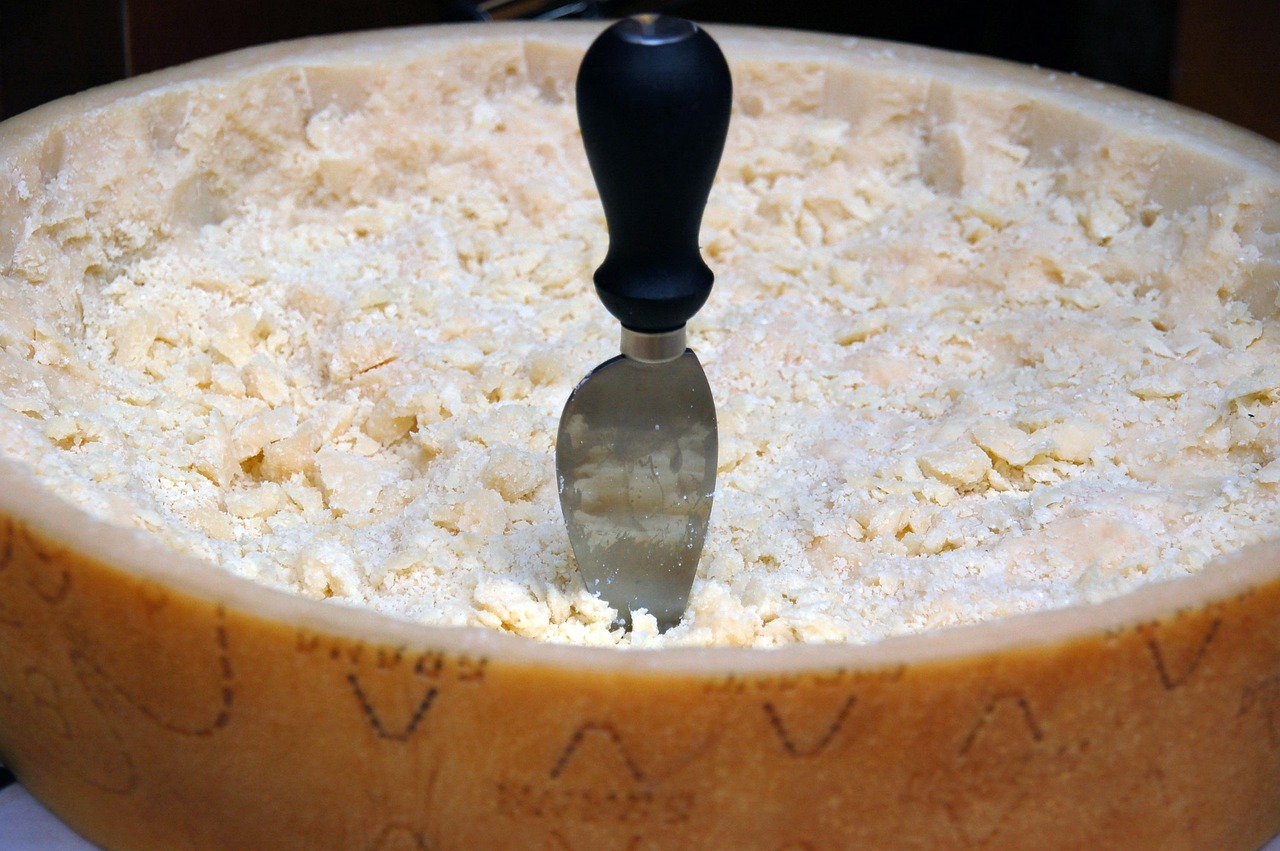
Time is the secret ingredient that transforms simple milk into the deeply complex Parmigiano-Reggiano. During aging, the cheese develops its famous crystalline texture and layered flavor: nutty, savory, and slightly fruity, with a satisfying crunch from naturally occurring amino acid crystals. Younger wheels tend to be creamier and milder, perfect for snacking, while older ones offer bolder, more concentrated umami—ideal for grating over pasta, risotto, or soup.
Each wheel is inspected by experts from the Parmigiano-Reggiano Consortium, the governing body that ensures authenticity and quality. Those that meet their rigorous standards are branded with the iconic dotted rind stamp—proof that you’re getting the real deal.
A Nutritional Powerhouse
Beyond its irresistible flavor, this cheese is a nutritional gem. It’s naturally lactose-free due to the fermentation process, making it digestible even for those with dairy sensitivities. Packed with protein, calcium, and essential amino acids, it’s a wholesome source of energy for athletes and food lovers alike. In fact, Italian pediatricians often recommend small shavings of Parmigiano for toddlers as a healthy, natural supplement.
Learn also more about the nutritional benefits of Brie Cheese.
Is Parmigiano-Reggiano cheese Vegetarian?
One question often asked by mindful eaters is whether this cheese is suitable for vegetarians. Traditionally, it is not considered vegetarian because the production process uses animal rennet, an enzyme extracted from the stomach lining of calves. The use of animal rennet is a strict requirement under the Protected Designation of Origin (PDO) rules—meaning that authentic Parmigiano-Reggiano can only be made this way.
In the Kitchen: Versatility at Its Finest
It is one of the most versatile ingredients in the culinary world. Freshly grated over pasta, it melts seamlessly into sauces, enhancing them with depth and richness. A few curls on a salad add a burst of umami, while slivers paired with balsamic vinegar create an elegant appetizer. Even the rinds—never to be wasted—can be simmered in soups or stews to infuse them with a subtle, savory note.
For an authentic Italian experience, try a chunk of aged Parmigiano with a drizzle of Aceto Balsamico Tradizionale di Modena and a glass of Lambrusco. The combination of salty, sweet, and sparkling captures the essence of Emilia-Romagna, the region where both delicacies are born.
Protecting a Culinary Treasure
In a world full of imitation cheeses, the Parmigiano-Reggiano Consortium plays a crucial role in protecting this heritage. Cheeses labeled “Parmesan” outside Europe are often pale imitations, lacking the depth and character of the original. True Parmigiano cheese bears a PDO (Protected Designation of Origin) seal, ensuring that every bite honors centuries of Italian craftsmanship.
A Taste of Timeless Italy
Parmigiano cheese isn’t just food—it’s a piece of living history. Each wheel represents the dedication of farmers, cheesemakers, and affineurs who have upheld a tradition passed down for generations. Whether shaved over your favorite pasta or savored on its own, it delivers a taste that’s at once ancient and eternal—a perfect harmony of nature, time, and skill.
So next time you reach for that familiar golden wedge, pause for a moment. You’re not just tasting cheese—you’re tasting Italy itself.